
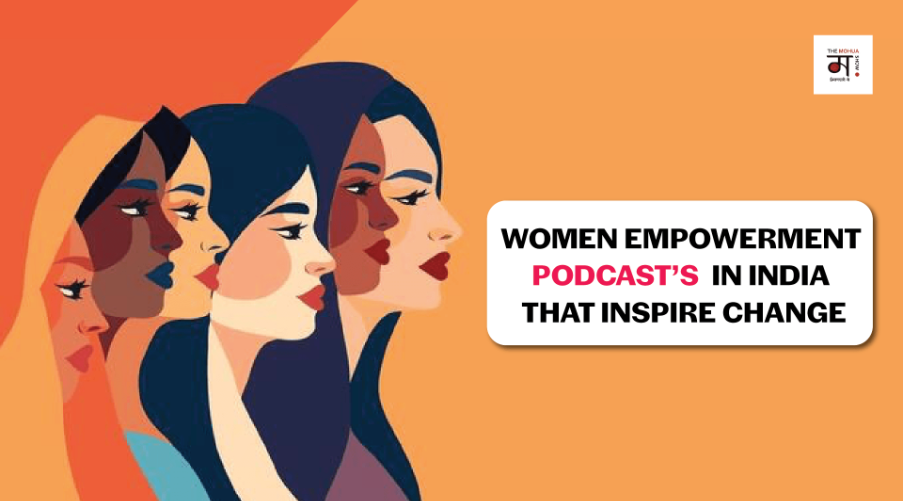
Female Empowerment Conversations in India Are Changing What It Means to Speak Up
Female empowerment conversations in India are not happening where you might expect. They are not on prime-time panels with a three-minute slot and a moderator with one eye on the clock. They are in audio long, unedited, unhurried between people who have earned the right to say what they came to say.
India has always placed women at the centre of its stories. What has changed is who controls the telling. Podcasts, more than any other format, have created a space where these conversations can unfold without someone cutting to commercials just when it starts to get honest. The Mohua Show, hosted by author and storyteller Mohua Chinappa, has become one of the most trusted homes for exactly this kind of conversation. Three of its episodes in particular stopped listeners mid-commute. This blog is about those three and two other Indian podcasts doing equally serious work in this space.
Why Female Empowerment Conversations Matter More Than Ever in India
There is no shortage of content about Indian women right now. The problem is that most of it is comfortable. Stories of triumph without the mess that surrounded them. Inspiration served without context.
What separates a genuinely useful female empowerment conversation from content that simply wears its language is a willingness to sit with difficulty to name the system that created the problem, not just applaud the person who survived it. Patriarchy is not only loud and violent. It is often quiet, well-meaning, and spoken in the voice of someone who loves you. Disability is not purely a story of overcoming. It is also a story about what a school, a city, a country refused to build. Sexuality education is not inappropriate, its absence is. These are the conversations that The Mohua Show keeps having, episode after episode, and the reason its listeners keep coming back.
Ep 177: Breaking Down Patriarchy — The Female Empowerment Conversation India Needed
There is a version of patriarchy that is easy to point at, hostile, dismissive, contemptuous of women. And then there is the kind that this episode is about: the one that says I’m only doing this for your own good.
In Episode 177, Mohua sits with Aparna Piramal Raje and Megha Mawandia for a conversation that is rarer than it sounds, one where the word “feminism” is neither weaponised nor softened into meaninglessness. They explore what they call benevolent patriarchy: the quiet limiting of women’s ambitions by people who genuinely believe they are being protective. A father who steers his daughter away from a risky career. A colleague who does not challenge a woman’s hesitation because he thinks she is being sensible. A woman who tells her daughter-in-law to keep the peace. The episode points out, carefully and without accusation, that this kind of patriarchy is perpetuated as much by women as by men, which is precisely what makes it so hard to dismantle.
What makes this episode worth returning to is its insistence on non-accusatory dialogue. The conversation does not want to win an argument. It wants to open a door. It discusses films like Barbie as unexpected vehicles for these conversations reaching mainstream audiences, and makes the case that creating spaces where men can engage with gender dynamics without feeling attacked, is not a compromise. It is part of the work.
🎧 Listen: themohuashow.com — Ep 177
Ep 176: Hope Teresa David and the Female Empowerment Conversation About Inclusive Education
Not every female empowerment conversation begins with gender. This one begins with a wheelchair and what India chose to do about a girl in one.
Hope Teresa David was born in 2011 with Spina Bifida Myelomeningocele, a condition affecting her lower limbs that required two surgeries within the first four months of her life. By the time she was a teenager, she had already undergone another major surgery to release a tethered spine and remove a bony growth from her spinal cord. Through all of it, she kept racing. She became India’s youngest wheelchair racer and the only para-athlete from Uttarakhand representing the sport. The FICCI FLO Uttarakhand chapter gave her an award for it.
Then Dehradun’s schools refused her admission.
Not one school. Multiple schools, each finding a different excuse. The story made national news, a notice was sent to the schools, and Hope’s family ultimately had to relocate to Bengaluru to find an institution that would accept her. She trained there. She competed. She won a medal at the Dubai Para Olympics.
In her conversation with Mohua, Hope says something simple that lands hard: “Wheelchair racing gives me a lot of self-confidence that I can do anything in life.” The episode holds that line and asks the quieter question alongside it, why should a girl have to find confidence in a sport because her schools would not give it to her in a classroom? This is the female empowerment conversation that refuses to stop at extraordinary. It asks what we owe the children our systems have not yet learned to see.
🎧 Listen: themohuashow.com — Ep 176
Ep 183: Reema Ahmad and the Female Empowerment Conversation Nobody Wants to Start
Of all the female empowerment conversations India avoids, the one about comprehensive sexuality education is among the most deliberately abandoned. It is the conversation that gets called western, inappropriate, someone else’s problem, while the consequences of its absence fall hardest on girls and children who have no other adult willing to name what is happening to them.
Reema Ahmad came to this work through literature, not medicine. She studied English at Lady Sri Ram College, taught creative writing to children in Agra, and became increasingly disturbed by how many children she encountered who had no language, no words at all, for what was being done to their bodies. She trained as a comprehensive sexuality educator, worked with families of child sexual abuse survivors through Counsel to Secure Justice, and co-founded Candidly, an initiative that addresses gender, sexuality, and abuse through culture and media. She has spoken at TEDx twice. Her first book on discussing taboo topics with children was in development with Penguin India.
In Episode 183, she and Mohua take apart the most common objection to comprehensive sexuality education, that it is adult content for children,, with patience and clarity. Reema explains that CSE does not start with sex. It starts with body autonomy, consent, and the right to say no. It gives children the vocabulary to name what is happening to them, which is the first step in being able to report it. The communities most underserved by formal healthcare, where a child may have no trusted adult, no family conversation, no school programme, benefit most. In that context, information is not permissive. It is protective.
This is a female empowerment conversation with measurable stakes. The discomfort it causes in some listeners is, the episode argues, significantly smaller than the discomfort caused by its absence.
🎧 Listen: themohuashow.com — Ep 183
Other Indian Podcasts Hosting Meaningful Female Empowerment Conversations
The Mohua Show is not alone in this work. Two other Indian podcasts, both currently active and publishing regularly are approaching female empowerment conversations with similar seriousness.
Women Uninterrupted — The Hindu
Now in its sixth season, Women Uninterrupted is a podcast by The Hindu that has quietly built one of the most honest archives of women’s voices in Indian audio. Hosted by Anna Thomas, it brings intergenerational conversations between women, a masseuse talking about her teenage daughter, a waste-picker who has become an international voice for her community, a drone entrepreneur navigating a household that had to be convinced along with her. Season 6 focuses on women working in the social sector, and the conversations are short, unvarnished, and specific in a way that polished productions rarely are. If The Mohua Show is the long-form room where ideas are unpacked, Women Uninterrupted is the kitchen table where lives are simply lived.
🎧 Listen: Apple Podcasts — Women Uninterrupted
Ladies Who Lead — Aabha Bakaya
Aabha Bakaya founded Ladies Who Lead in 2021 after years as a business journalist, specifically to bridge the opportunity gaps that gender bias creates for women in professional life. The podcast, now in Season 2, carries the warmth of that original intent. Episodes include conversations with entrepreneurs, educators, and industry leaders, women who have built something and are honest about what it cost. A recent episode with Zerodha’s Nithin Kamath explored what it takes to mentor women in finance, which is a less common angle than the usual founder story. The podcast sits at the intersection of ambition and accountability, which is exactly where the most useful female empowerment conversations tend to land.
🎧 Listen on Spotify: Ladies Who Lead with Aabha Bakaya
What Makes a Female Empowerment Conversation Worth Your Time
Not every podcast that uses the language of empowerment actually advances the conversation. The ones that do tend to share a few qualities.
They name the system alongside the individual. The story of a woman overcoming adversity is moving. But it becomes genuinely empowering only when it also asks, why was there adversity to overcome in the first place? The episodes featured here do both. They honour the person and interrogate the structure that made their path harder than it needed to be.
They resist clean conclusions. Real life is messy, contradictory, and often unresolved. The best female empowerment conversations allow guests to speak without being pushed toward a tidy takeaway. Mohua’s instinct as a host is to stay in the difficulty rather than wrap it, and it shows in the quality of what her guests share.
They include the voices that are hardest to hear. A para-athlete whose schools turned her away. A sexuality educator from Agra working in communities that formal healthcare has never reached. These are not the voices that get booked on prime-time. But they are the ones carrying the most important parts of the conversation.
Frequently Asked Questions
What is a female empowerment conversation in the context of Indian podcasts?
In the context of Indian podcasts, a female empowerment conversation goes beyond motivation and success stories. At its best, it combines personal testimony with structural thinking exploring how gender, caste, disability, class, and other realities intersect in shaping women’s lives. Shows like The Mohua Show create the time and space for these conversations to breathe, which is what makes them different from shorter-form content.
Where can I listen to The Mohua Show’s female empowerment episodes?
All episodes are free to listen on Spotify, Apple Podcasts, YouTube, and at themohuashow.com. The three episodes featured in this blog, Ep 177 on patriarchy, Ep 176 on inclusive education, and Ep 183 on sexuality education are directly linked above each episode section.
Why are Indian podcasts becoming important spaces for these conversations?
Podcasts allow long-form conversations that mainstream media rarely makes space for. They reach listeners during commutes, household routines, and quiet evenings, without requiring full attention. For topics that are sensitive, personal, or structurally complex, audio has proven to be one of the most trusted and intimate formats. There is no camera to perform for. The conversation can go where it needs to go.
Who is Mohua Chinappa and why does her show stand out?
Mohua Chinappa is an Indian author, podcaster, and storyteller. Her approach as a host, genuinely curious, deeply researched, unhurried,, creates conditions for guests to speak honestly rather than perform. She consistently platforms voices that are underrepresented in mainstream Indian media. That is why The Mohua Show has become one of the most trusted spaces for female empowerment conversations in India, and why episodes from 2024 are still being listened to and shared well into 2026.