
The question of whether women are the most natural allies to queer communities has been circulating through academic circles, activist spaces and cultural discourse for decades. Both groups live within a world shaped by patriarchal norms, systemic hierarchy and historical erasure. Women have fought for the right to be authors of their own stories, and queer people have fought to simply exist without punishment or ridicule. If both groups share a common struggle against the same power structure, does that automatically make women the best allies for queer people?
The relationship appears intuitive at the surface. Women and queer individuals have both experienced exclusion from dominant narratives. They have both been spoken for rather than spoken to. They have both been conditioned to fit into roles designed by others. The shared understanding of oppression creates a compelling sense of familiarity. Many feminist scholars have pointed out that empathy does not have to be taught between two groups who know what it means to be marginalised.
Yet history, lived experience and activism reveal a more complex truth. Common oppression does not always translate into common solidarity. In fact, marginalised communities are not inherently safe spaces for each other. A group can be oppressed and still hold privilege within another context. A woman can experience misogyny yet uphold heteronormativity. A queer person can resist homophobia yet disregard the specific struggles of women. The internal politics of identity, power and belonging are never linear.
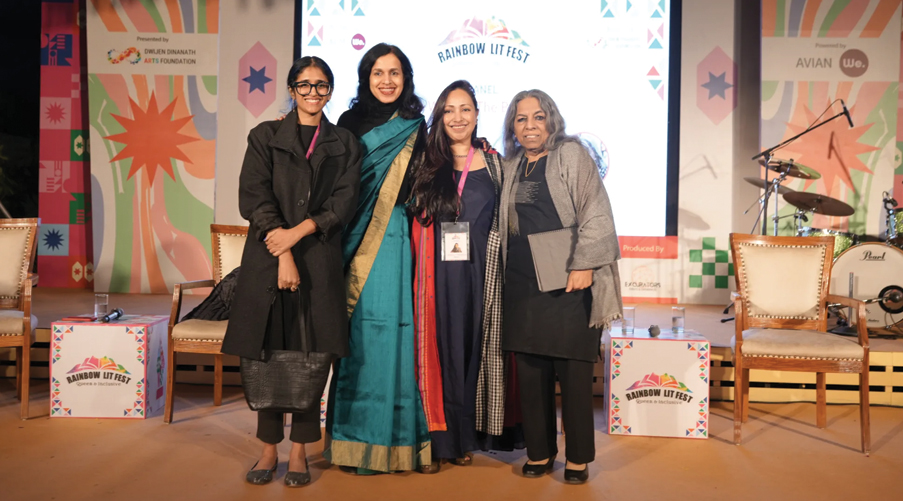
This complexity is what makes the upcoming discussion at the Rainbow Literature Fest so significant. Madhavi Menon, Mohua Chinappa and Urvashi Butalia, each bringing profound intellectual, feminist and literary depth, sit down with Sindhu Rajasekaran for a conversation that challenges assumptions surrounding allyship. Their dialogue examines where alliances between women and queer communities have been transformational, and where they have quietly fallen apart.
They look beyond celebratory slogans and into the realities that shape relationships across marginalised groups. They explore how feminist movements have not always represented queer voices, and how queer narratives sometimes centre male experiences while sidelining the contributions of women. They discuss how intersectionality is not just a theoretical concept but a lived demand for dignity across caste, class, gender, sexuality and geography.
One of the most powerful threads in this discourse is the question of whether empathy alone is sufficient for allyship. Can solidarity exist without a shared identity? Does understanding require personal experience, or can listening and accountability become the bridge? And perhaps the most uncomfortable yet necessary question of all: does allyship sometimes remain symbolic rather than structural?
The conversation moves toward possibility rather than pessimism. If allyship has faltered in the past, there is space for it to evolve. Women and queer individuals occupy two of the most historically censored positions in literature and storytelling. When they come together as collaborators rather than parallel fighters, they build a cultural force capable of reshaping narratives entirely. They expand representation beyond tolerance and toward transformation.
This spirit aligns deeply with the heart of the Rainbow Literature Fest. It is not a space created only to showcase queer stories, but a space designed to challenge the systems that shape who gets to tell a story and who gets to be remembered. It is a space that values questions as much as answers and sees dialogue as a form of activism.
The session does not aim to declare whether women are or are not the best allies. Instead, it pushes us to rethink how alliances are built. True solidarity requires not only similarity in oppression, but humility, accountability and a willingness to act. It asks for relationships that are not rooted in assumption but in choice. It demands that communities stand beside one another not because tradition tells them to, but because justice requires it.
Perhaps the real question is not whether women are the best allies, but whether each of us is willing to become the kind of ally that moves beyond identity and into responsibility. The conversation at the Rainbow Literature Fest opens the door to that possibility, and to an imagined future where solidarity is not inherited, but built deliberately — word by word, story by story, movement by movement.