

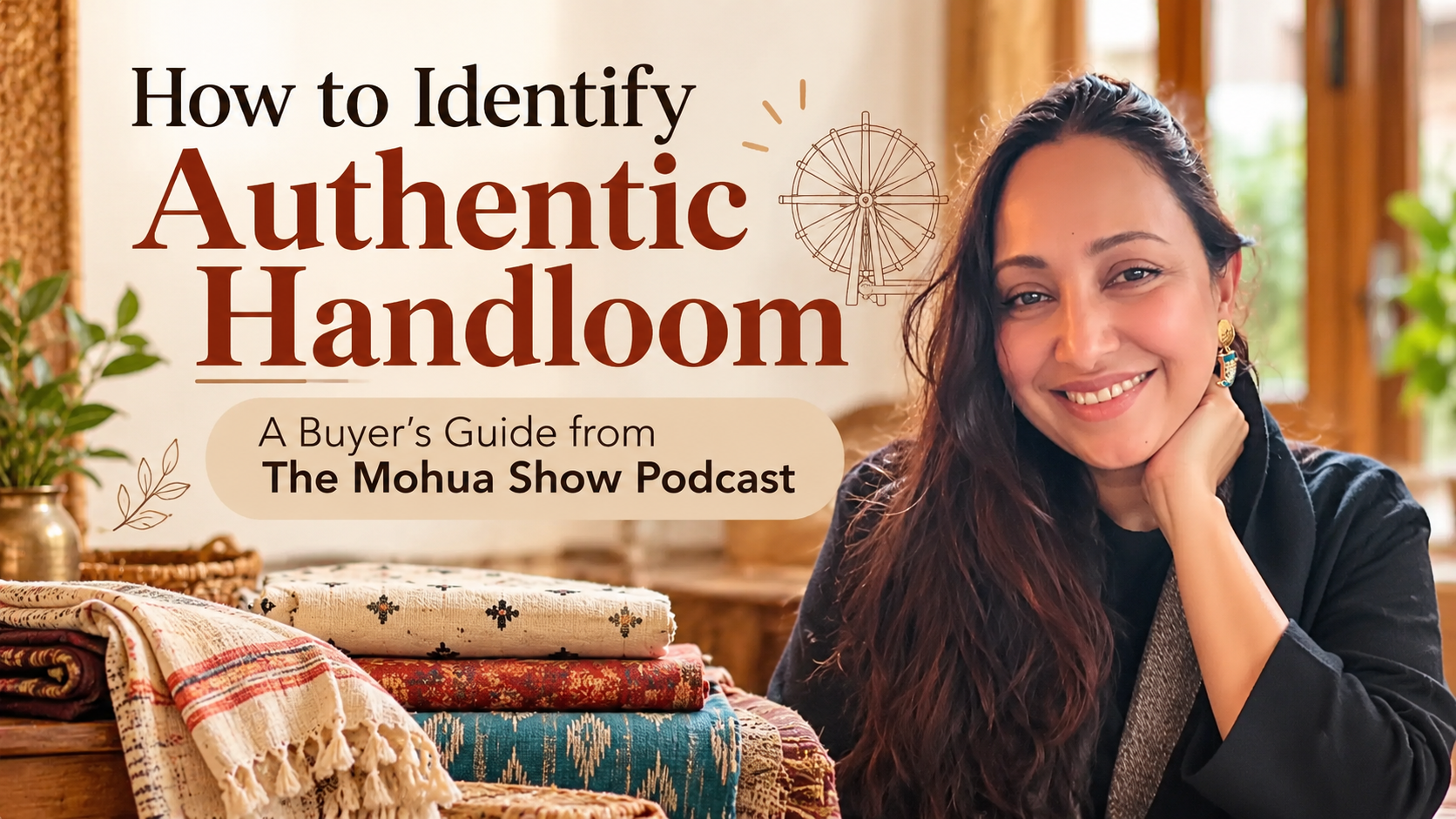
Knowing how to identify authentic handloom is the difference between paying a weaver and paying a factory. A saree tagged “handloom” may come off a power loom, and a “hand-painted” print may be digital. Most of us cannot tell by looking, and the tags rarely help.
In Episode 301 of The Mohua Show, host Mohua Chinappa put a blunt question to Vayaka founders Priyanka Rajwar and Roli Mishra: is fashion killing the very crafts it celebrates? This guide combines that conversation with official census data so you can shop with your eyes open.
Why authentic handloom matters: the numbers behind the cloth
The Fourth All India Handloom Census (2019-20) recorded about 31.45 lakh handloom households and 35.22 lakh weavers and allied workers, more than 72% of them women, working across 28.20 lakh looms. The same census found that 67.1% of handloom-worker households earned less than ₹5,000 a month from all sources.
The workforce is also shrinking. An NCAER analysis notes that the number of handloom workers fell from 43.32 lakh in 2010-11 to 35.2 lakh in 2019-20. When you pay fairly for authentic handloom, the money reaches rural, mostly women-led households. When a power-loom copy is sold as handloom, it undercuts the weaver who made the real thing.
Handloom vs powerloom vs digital print: what is the difference?
- Handloom: woven on a loom worked by the weaver’s hands and feet. Every metre involves human skill and time.
- Powerloom: woven by a motor-driven machine. Faster and cheaper, and it can imitate handloom designs closely.
- Digital print: a design printed onto finished cloth, often made to look like woven motifs or traditional prints.
None of these is “bad”. The problem is selling one as another.
7 checks to identify authentic handloom
No single check is conclusive. Use several together.
- Turn it over. In woven motifs, the reverse often shows small floats or thread ends. Printed fabric usually looks paler or plainer on the back.
- Look for honest irregularity. Slight variation in thread tension or edges is common in handwork. Be careful, though: skilled weavers produce very even cloth, so perfection alone does not prove a machine made it.
- Read the fibre label. Pure cotton, silk or wool should say so. Blends are not fake, but they should be disclosed. The episode covers pure versus blended fabrics at length.
- Feel and drape. Authentic handloom cotton typically softens and breathes better with wear. A stiff, slightly synthetic sheen can signal polyester.
- Ask for provenance. Look for the Handloom Mark from the Ministry of Textiles or a Geographical Indication tag where relevant, and ask which cluster or cooperative made it.
- Do the time-and-price maths. Complex handloom can take days or longer on the loom. A price that makes no sense for that labour is a warning sign.
- Ask who made it. Genuine sellers can usually name the weaver, village or group. Vague answers are a red flag.
Mislabeling: when the name on the tag does not match the cloth
The episode flags the mislabeling of crafts such as Bhujodi, a Kutch weaving tradition. When a craft name becomes a trend, it gets stamped on products with no real link to the craft. For buyers, the lesson is to treat craft names as claims to verify, not guarantees.
Kalamkari: a hand-drawn art, not just a print
The conversation walks through the traditional process behind Sri Kalahasthi Kalamkari. This style is traditionally drawn freehand with a pen (kalam) and coloured with natural dyes, unlike block-printed styles from other regions. Digital prints can copy the look but not the process or the livelihood behind it.
Kala cotton and conscious buying
The episode also covers Kala cotton, an indigenous cotton from Kutch discussed in the context of sustainability. Conscious buying here means choosing fibres, processes and makers with a lower environmental footprint, and accepting that this usually costs more.
So, is fashion killing Indian crafts?
The episode’s answer is nuanced. Fashion can raise visibility for handloom, but it can also push prices down, encourage lookalikes and make weaving a less attractive career for younger generations. Your purchase is one of the few levers that can shift this. The episode ends with one conscious choice every listener can make. Add the guest’s own words here with a timestamp (36:00 and 37:16 are the relevant chapters).
FAQ
How can I tell if a saree is handloom or powerloom?
Combine several checks: the reverse side, fibre label, certification, price against labour, and the seller’s ability to name the maker. No single test is enough.
Is authentic handloom always pure cotton or silk?
No. Handloom can use blended yarns. What matters is that the weaving is done by hand and the fibre is labelled honestly.
What is the Handloom Mark?
A Ministry of Textiles mark meant to certify that a product is handwoven. Verify the current scheme on the ministry’s site before quoting details.
Why is authentic handloom expensive?
Because it is slow, skilled, mostly manual work, and the weaver’s income depends on a fair price.
Listen to the full conversation
Hear the full discussion in Episode 301: Is Fashion Killing Indian Crafts? on Spotify, Apple Podcasts or YouTube.
Sources: PIB, National Handloom Day 2026 factsheet (Fourth All India Handloom Census 2019-20); Drishti IAS editorial of 7 Aug 2026 summarising census income data; NCAER, “Counting Handloom Weavers in India”; The Mohua Show Ep 301 description.
Verify before publishing: Handloom Mark scheme details; Kalamkari process wording against the episode audio.